


What we Do
Airborne Geo Exploration - AirGeoX is an Australian UAV airborne geophysical survey and sensor technology company, specialising in high‑resolution magnetic data acquisition using advanced UAV platforms.
AirGeoX is well recognised for its long‑standing UAV‑based magnetic survey operations, delivering reliable results across a wide range of terrain types throughout Australia.
Since commencing operations in 2020, AirGeoX has flown more than 130,000 kilometers across all Australian States capturing high‑resolution magnetic survey lines with our high quality in-house developed Magnetometers. We provide explorers with consistent, high‑quality datasets derived from proven long endurance Multirotor & VTOL Fixed Wing Drones and supporting field systems.
Why AirGeoX
Our early work was enabled by the first‑generation TotalMag™ magnetometer, a highly sensitive, low‑noise UAV magnetic survey solution designed specifically for low‑altitude operation.
Building on this operational experience, AirGeoX / AIRGEO is now advancing an all‑new second‑generation airborne magnetic system, incorporating improved sensing, navigation, and system integration to meet evolving exploration and environmental requirements.
While this website represents legacy AirGeoX, our field survey capability and operational experience remain unchanged. What has advanced is the technology we deploy and the broader intelligence services we now deliver.
AirGeoX is currently undertaking a broader technology and capability refresh, with a new, technology‑focused website at AirGeo Exploration & Discovery www.airgeo.au, showcasing our latest developments and future direction.
UAV Magnetic Survey
AirGeoX achieves exceptional UAV survey magnetic data quality through low‑altitude flight profiles—typically 30–40 metres AGL—combined with careful sensor isolation, with magnetometers positioned up to 20 metres from the aircraft to minimise platform noise. High‑end magnetometer sensitivity and disciplined system design ensure consistently low‑noise, high‑fidelity data.
MagBird
The new CAD engineered and Australian manufactured Generation 2 magnetometer MagBird contains;
-
High sensitivity, low noise QTFM2 optical magnetometer at 60Hz
-
Custom built acquisition system in a robust highly aerodynamic & stable sensor platform
-
1.2m long and wingspan
-
L1 L2 GNSS
-
LW20 Laser altimeter
-
10 degrees of freedom IMU
-
20m cable attached to 4-point bridle for better sensor stability in flight
-
Live telemetry - location, attitude and mapping
-
Standard tail variant
-
Gradiometer twin wings variant
-
Tri-sensor wings/tail variant
-
MagBird Ground Station telemetry and diagnostics

Magnetic Data
The value of drone magnetic data is not realised until the data is zoomed into a very high resolution and enhanced to it’s signal to noise limit, such as a second vertical derivative.
With the significant improvement in resolution of magnetic data, explorers, miners and engineering firms will have the confidence to commit resources towards drilling, knowing that any drill holes will accurately hit the targeted geology.


Magnetic Data from GeoScience Australia & Comparison AirGeoX


Learn About Magnetic Data
Drone magnetics is a highly technical, complex field. Below is a range of articles to read, learn and understand why both drone magnetics and in particular AirGeoX’s TotalMag system produces the highest quality magnetic data in the world.
The primary benefit of drone magnetics over manned airborne magnetics is the greater resolution and greater amplitude of geological units primarily from the lower flight height. This allows geologists to map more geological structure that will produce more accurate drill hits and increase the likelihood of hitting a deposit. But just how much greater is the resolution?
Above is a comparison between an AirGeoX drone magnetic survey (3.5km x 2km) for Aeris Resources Limited that had been flown by Geoscience Australia and released for the Cobar 2021 magnetic survey. (https://ecat.ga.gov.au/geonetwork/srv/api/records/146166).
The top image is the Geoscience Australia TMI RTP 2VD (highest resolution produced) image collected by a manned aircraft in 2021. The line spacing was 200m, flown E-W at an altitude of 60m.
Next to the first Geoscience image, is the AirGeoX TMI RTP 2VD (highest resolution) image. Lines were flown E-W, 25m line spacing at a height of 30-35m.
Technology
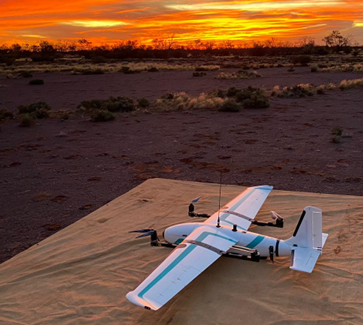
AirGeoX select and modify drones to meet the needs of geophysical surveys. For the highest positional accuracy, AirGeoX drones are equipped with two dual band RTK GPS, triple redundant IMU and an autopilot that recalculates 200 times per second how to counteract wind.
AirGeoX have flown over 130,000 kilometres by equipping drones with RFD900x long range communications and large, long endurance Cube Orange Autopilot powered drones. Surveys of thousands of kilometres are now possible over extended field mission deployments.


Depth BG
Low Cost Depth to Basement Model derived from Drone Magnetics
What is DepthBG?
DepthBG is a high resolution map of shallow bedrock or basement structure to a very high resolution and detail using ultra high resolution drone magnetic data as the primary input. DepthBG can be imported into your GIS software to illustrate bedrock structure that may contribute to the deposition of economic mineralisation, such as alluvial gold, identify whether mineralisation is at an economic depth to mine, determine the optimal drilling technique based on the depth to basement within your tenement.

DepthBG can also be used for mapping bedrock for geotechnical or engineering applications for depths greater than 20m.
The technique is accurate for all depths greater than 20m depth, but illustrates reasonable results as shallow as 10m depth.
Why use DepthBG?
-
Does basement structure control your target mineralisation? Is your area covered with regolith and you want more information on the structure of the basement?
-
Do you need to know if a potential prospect is too deep to be economically mined before risking a lot money drilling out the prospect?
-
Are you planning a drilling campaign but can’t accurately budget because you don’t know the depth to basement?
-
Are you unsure as to which drilling technique to use because you’re unsure how the depth to basement varies across your tenement?
-
Cost effective method for infrastructure / geotechnical applications compared to seismic, MASW, GPR etc.
DepthBG will give you the confidence in a cost effective and non invasive way to make a decision on all of the items above before spending money on drilling.


Radiometrics
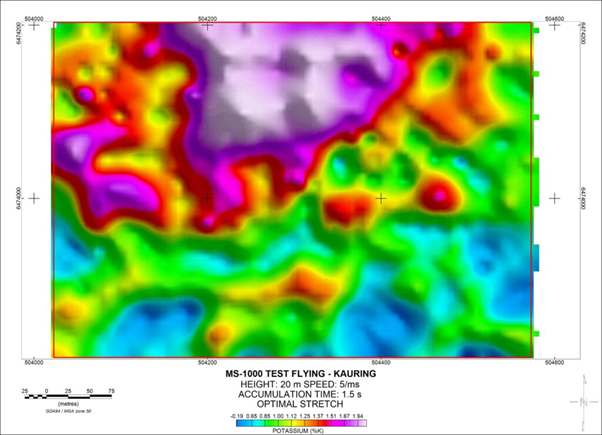
The benefit of drone radiometrics is a lower flight height, which produces a significantly smaller footprint and therefore higher resolution data. The footprint is reduced from approximately 100m for a plane flying at 50m altitude, down to 30-40m for a drone flying at 20m altitude.
AirGeoX have chosen to operate the Medusa MS-1000 spectrometer as it’s a large CsI crystal with 1000cc volume, 4 times larger than other drone spectrometers and it has the ability to acquire and deliver up to 2048 channels at varying sample times.
A challenging test area with very low counts and no outcrop clearly illustrates geological structure of 25m resolution, when flown at 20m altitude and 25m line spacing. Many small scale structures are identified that could otherwise only be identified by walking a spectrometer.

Drone radiometrics has the ability to map Cesium, which is useful for detecting outcropping lithium. The maximum amplitude of Cesium in the area is a total of 70 x 10-13 PPM, which illustrates the excellent signal to noise ratio at such low signal strength.



If you’re an explorer for Uranium, rare earth elements, lithium or require any high resolution structural mapping over outcropping areas, drone radiometrics will produce a higher resolution and high quality dataset not able to be produced by any other method.

About Us

Managing Director | Chief Engineer – AirGeoX and AirGeo Exploration & Discovery
David Alam is the Founder and Managing Director of AirGeoX, a role he has held since 2019, leading the company’s transformation into an Australian specialist in advanced airborne geophysical and environmental intelligence services.
With a professional background spanning aviation, engineering, and commercial leadership, David combines hands‑on operational experience with system‑level technical oversight and long‑term business strategy. He is a CASA‑accredited Chief Remote Pilot and aircraft owner‑operator, with operational experience across UAV helicopter, multirotor, VTOL fixed‑wing, and long‑range autonomous platforms.
In addition to his executive leadership role, David acts as Chief Engineer and Technical Lead for the MagBird® development program, overseeing the architecture and integration of airborne magnetic survey systems. This includes sensor integration, navigation and positioning, power systems, flight platforms, and end‑to‑end data workflows.
The MagBird program reflects David’s focus on building robust, Australian‑designed technology that performs reliably in real‑world operating environments and meets the expectations of exploration companies, environmental managers, and government stakeholders.
Strategically, David’s work is focused on the long‑term evolution of AirGeoX—expanding capability beyond data acquisition toward decision‑ready insight, supporting applications such as mineral exploration, environmental baseline and rehabilitation studies, infrastructure planning, and public‑sector geoscience initiatives.
He is recognised for a values‑led, ethical, and practical leadership style, with a strong commitment to engineering fundamentals, aviation safety, and long‑term client relationships. A lifelong passion for aviation underpins his approach to system design, operational discipline, and continuous improvement.
Qualifications:
• Chief Engineer and Technical Lead on MagBird development platform
• Bachelor of Business from University of Southern Queensland
• CPA Finance and Accounting
• CASA Chief Pilot Certified
• CASA Remote Pilots License
• CASA Aeronautical Radio Operator Certificate
Experience:
• Mag Sensor Systems construction
• UAV construction and system configuration
• Cube Orange autopilot UAV installation and other advanced UAS avionics
• CASA accredited Chief Remote Pilot RPAS systems operator
• UAV VTOL Fixed Wings
• UAV Multirotor
• UAV Helicopter <25Kg Owner Operator
• UAV operations aerial photography data collection and management
• AirGeoX UAV exploration magnetic & hyper-spectral surveying

Get in Touch
Contact us by phone: 0475 983 244
Contact us by Email: david.alam@airgeox.com
Contact us by LinkedIn: David Alam